Mahjong
- 4.8
- Rating
- 10.00M
- Installs
- Free
- Price
 Analysis by App-foxy
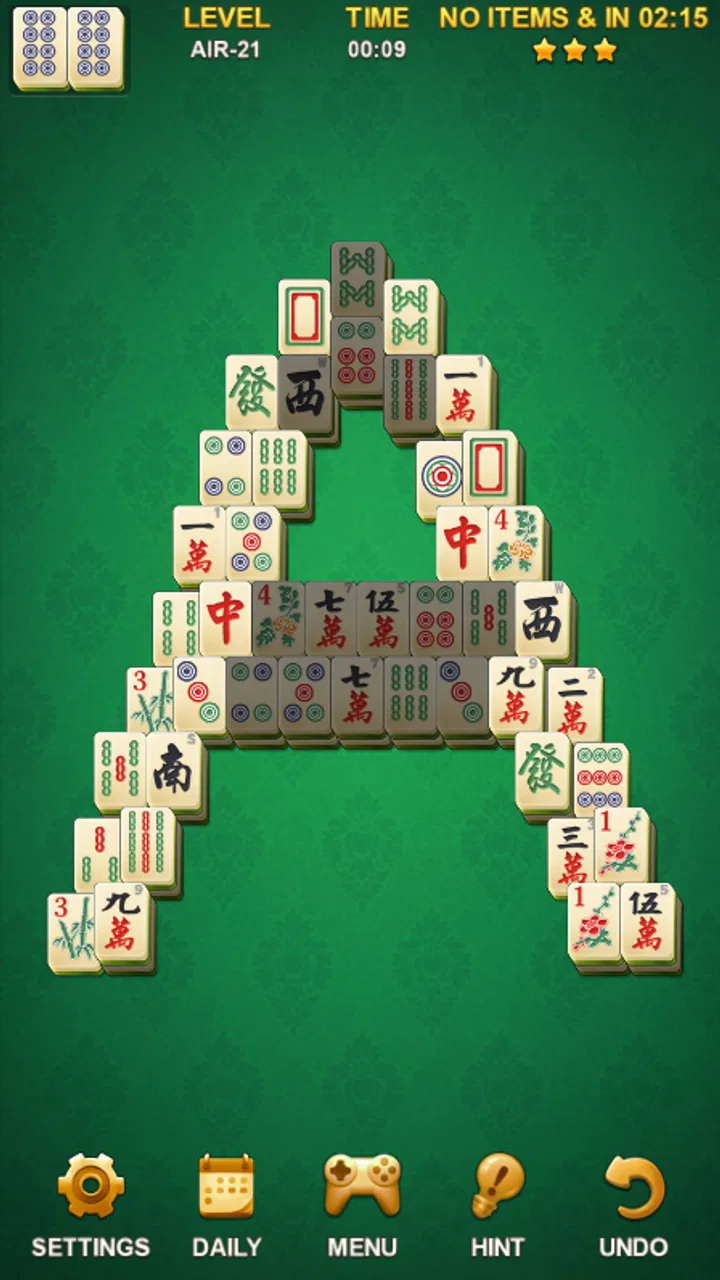
I spent time with Mahjong as a quiet, pick-up-and-play puzzle rather than treating it like a competitive game. That distinction matters. This is the familiar tile-matching format often called Mahjong Solitaire: the board gives you layered groups of tiles, and your job is to remove matching pairs while keeping enough useful moves available for later. It is easy to understand within a minute, but making consistently good choices takes more care than the simple rules suggest.
My first impression was that the game is built for short sessions. I can open it when I have a few spare minutes, make progress without preparing a complicated strategy, and stop without feeling that I have abandoned a long campaign. That makes it a natural fit for a waiting room, a commute, or a quiet break. At the same time, the puzzle has enough planning to reward concentration, so it does not feel like a completely mindless way to fill time.
How the current Mahjong experience feels
The core appeal is the balance between recognition and restraint. Matching two identical tiles is straightforward, but not every available pair is equally valuable. Removing one pair can expose several tiles, while another choice may leave the board awkwardly blocked. I found myself scanning the layout before tapping, especially when multiple pairs were visible. That small pause is where the puzzle becomes more interesting than a simple matching exercise.
You May Also Like

 Blood Strike: 2.5 Anniversary
Blood Strike’s Loadouts Turn Every Drop Into a Tactical Gamble
A close look at Blood Strike’s custom loadouts: how fast access to signature weapons reshapes its battle royale rhythm, rewards preparation, and narrows the gap between fights.

 Pandora - Music & Podcasts
Pandora’s Music Is Easy to Start, but Harder to Recover
Pandora’s strength is its low-effort path from a seed to a station. Its weak spot is how much confidence it asks you to place in connection, setup, and quiet recovery.

 8 Ball Pool
 Is Built on Rivalries, Rematches, and Routine
A close look at the rivalries, rematches, shared routines, and unanswered safety questions that turn a quick pool match into a persistent mobile community.

 Samsung Music
’s Quiet Strength Is Playing What You Already Own
Its reach comes less from spectacle than from dependable access to a personal library. That simplicity is both the app’s strongest retention engine and its ceiling.

 AccuWeather: Weather Radar
AccuWeather Review: A Quick, Clear Forecast for Everyday Decisions
For everyday plans, the best forecast is the one you can understand quickly. AccuWeather makes rain timing, radar, and local conditions easy to act on, with a few trade-offs.

 Hill Climb Racing
Why Hill Climb Racing Still Turns Crashes Into One More Run
A tiny car, a bumpy hill and one more upgrade: Hill Climb Racing keeps resurfacing because its simple chaos makes every near-miss feel personal.
More From Our News Desk
View All News


Mahjong is a free puzzle game from CanaryDroid, aimed at an Everyone audience. It has reached over ten million installs and holds a 4.8 average from around 480 thousand ratings, with roughly 76 thousand written reviews. Those figures suggest that the format has connected with a broad Android audience, but popularity alone does not make every session satisfying. In my experience, its strongest quality is how quickly it gets out of the way and lets the board become the focus.
The game is also approachable for people who have never played this style before. You do not need to know the rules of traditional four-player Mahjong, and that is an important clarification. This is a solo board puzzle, not a tile-based table game with opponents, betting, or a long rulebook. If you are looking for a relaxed matching challenge, the presentation is understandable. If you want the social strategy of traditional Mahjong, this is the wrong category of experience.
Why the simple rules still create decisions
A useful habit is to look for tiles that are doing more than one job. If a pair can be removed now, I check whether either tile is covering a useful symbol underneath or blocking access to an edge. I also try not to spend an obvious pair automatically when it is the only route toward a crowded section. This is not advanced theory, but it changes the game from tapping matching pictures into managing the order in which the board opens.
When I play casually, I usually make a quick scan from the outside toward the center. Edge tiles are often easier to access, while central stacks can hide the information needed for a later decision. On a difficult-looking layout, I mentally note pairs that are currently available and avoid removing one until I understand what it reveals. This approach is particularly helpful for players who tend to run out of moves because they clear whatever catches their eye first.
Another practical tip is to treat the board as a limited-information puzzle. You cannot plan perfectly when covered tiles are still hidden, so the goal is not to predict the entire solution. I aim to preserve flexibility: remove pairs that uncover several possibilities, and be cautious with moves that leave a narrow path. That mindset makes losses feel less random and gives each restart a clear lesson.
Who will enjoy it most
I would recommend this game to someone who likes visual puzzles, calm repetition, and sessions that can be stopped at almost any point. It works especially well for players who enjoy improving their own decision-making rather than chasing a story or competing on a leaderboard. Older family members may also find the basic interaction approachable, while experienced puzzle players can still appreciate the small tactical choices hidden inside familiar rules.
It is less suitable for anyone expecting a rich progression system, character collection, narrative campaign, or fast action. The pleasure comes from solving boards, not from unlocking a world. Players who need constant novelty may find the central loop repetitive after the initial appeal fades. I would also steer competitive players toward a game designed around head-to-head matches or timed rankings, because this experience is fundamentally solitary.
A realistic everyday use case is a short break between tasks. I can start a board while waiting for an appointment, focus for a few minutes, and put the phone away when my name is called. The game does not demand the emotional commitment of a story chapter, and a brief session still feels complete if I clear a useful section of the layout. That makes it more practical than many puzzle games that punish interruption or rely on long timed rounds.
What the version history means for existing players
The current version is 1.7.2, and the game was released on September 17, 2018. That combination tells me this is an established product rather than a brand-new experiment. For an existing player, the main benefit of a mature release is familiarity: the basic experience has had time to settle into a recognizable form. I would approach it as a dependable board-puzzle option, not as a game promising a constantly changing live-service experience.
The Android requirement is version 6.0 or later, which keeps the potential device range fairly broad. That is useful if you are installing it on an older Android phone or a spare tablet rather than a recent flagship. I would still judge the experience on the actual screen you plan to use: tile recognition is central, so a cramped display or uncomfortable touch response can affect enjoyment more than raw device power.
For current users, the update number is most useful as a compatibility reference. If the game is already installed and working well, there is no reason to assume that a version label alone will transform the puzzle loop. The important question is whether you enjoy the existing style of play. I would not install it expecting a completely different genre after updating; the identity remains that of a straightforward Mahjong Solitaire board game.
That stability can be a strength. A player who likes returning to the same kind of mental exercise does not have to relearn a new system every time. It can also be a limitation for people who want visible evolution, regular new modes, or a sense that every session introduces a fresh mechanic. The available information supports treating version 1.7.2 as the current reference point, while future changes should be judged by what they actually add rather than by the version number itself.
How it compares with familiar alternatives
Compared with match-three games, Mahjong offers less immediate spectacle and more attention to board order. A match-three title usually encourages rapid reactions and chain-building, while this game rewards identifying safe pairs and preserving access. If you enjoy colorful cascades and constant movement, the other format may feel more exciting. If you prefer a slower puzzle where one careless choice can matter several moves later, Mahjong is the better fit.
Compared with traditional Mahjong apps, this one is much easier to enter because there are no opponents or table rules to learn. You do not need to understand scoring systems, winds, hands, or turn order. The trade-off is depth of a different kind: you lose the social and strategic tension of playing against people, but gain a private puzzle that can be enjoyed without scheduling a match or learning a specialized vocabulary.
It also differs from word puzzles and Sudoku in the type of information it asks you to process. Sudoku is about numerical constraints, while word games depend on language and vocabulary. Here, the challenge is visual organization and move sequencing. That makes it a good alternative when I want concentration without reading, but not ideal when I am specifically looking for a puzzle that exercises language or formal deduction.
Small decisions that improve a session
I recommend checking the whole board before making the first move, even when the opening seems obvious. Look for pairs that are buried behind other tiles, then identify which available match is likely to expose the most useful space. This takes only a few seconds and reduces the common mistake of clearing a convenient pair that leaves the important area untouched.
When several identical tiles are available, I avoid thinking only in terms of “can I remove this?” I ask “which copy is safer to remove first?” The answer often depends on what each tile is covering or blocking. Choosing the less restrictive copy can preserve options for the next turn. This is one of the most satisfying details of the game because the symbols are simple, but their positions create different consequences.
I also suggest using a restart as a learning tool rather than as a sign that the game is unfair. If a board collapses late, I remember the move where flexibility disappeared and try a different order. That method is more productive than tapping rapidly through the same opening. It is especially valuable for players who want a calm puzzle but still enjoy gradually improving their judgment.
For a relaxed session, I would not force myself to finish every board in one sitting. The game is at its best when it remains a small mental break. If I am tired or distracted, I make more impulsive matches and enjoy it less. A short pause can be better than pushing through, because the puzzle depends on noticing relationships between tiles rather than merely clearing them as quickly as possible.
Where the experience may fall short
The central loop is also the main limitation. Once you understand the rhythm of selecting accessible pairs, the game can begin to feel familiar in a way that some players will interpret as relaxing and others will call repetitive. There is no need to pretend that the basic puzzle suddenly becomes a broad adventure. Its value depends on whether you like returning to a focused visual task.
The lack of social pressure is another trade-off. I appreciate being able to play alone, but someone who needs direct competition, shared rooms, or a strong achievement chase may find the experience quiet to the point of being thin. Likewise, players searching for a story or a long-term collection project should choose a different puzzle category rather than hoping this one will supply those motivations.
Because the game is free, it is easy to try without a purchase decision, and its Everyone rating makes it broadly accessible. Still, “free” should not be confused with “perfect for everyone.” The real cost can be attention: if you already have several similar tile-matching games, this may not offer enough difference to justify keeping another icon on your phone. I would install it when I specifically want this uncluttered solitaire format.
Device age is worth considering too. Android 6.0 compatibility is helpful, but an older phone can still make a tile puzzle unpleasant if the display is small or touch input feels imprecise. Before judging the game itself, I would give it a few minutes on the device where I intend to play. Clear tile visibility and comfortable tapping matter more here than advanced graphics.
My recommendation and what to watch next
My overall view is positive, with a clear qualification: Mahjong is good at being a focused, familiar board puzzle, and it should be chosen for that reason. CanaryDroid’s game suits short breaks, quiet evenings, and players who enjoy planning the order of simple moves. It is free, widely used, and available for a broad range of Android devices, but those facts do not change the basic truth that the experience lives or dies by your tolerance for repetition.
I would recommend it to a friend who says, “I want something relaxing, but I still want to think.” I would not recommend it to a friend asking for a story, multiplayer rivalry, or frequent mechanical surprises. In the first case, the board gives enough small decisions to keep a session engaging. In the second, a more feature-heavy puzzle game would probably be a better use of storage and attention.
Existing players should watch future updates for meaningful changes to the way boards are approached, not just a new number beside the version. New layouts can extend the life of the format, but the most valuable improvements would be those that make planning clearer without removing the calm simplicity. I would also pay attention to whether the game remains comfortable on older Android hardware, since accessibility is part of its practical appeal.
For a new player, my best advice is to begin slowly: scan the board, prioritize moves that open space, and do not confuse the first available match with the best match. That habit reveals the puzzle’s real character. The strongest reason to try Mahjong is its low-pressure decision-making, not a promise of endless novelty. If that sounds like the kind of break you want, this established free game is an easy choice to test and a pleasant one to keep.
After playing it with that expectation, I found the experience dependable rather than flashy. It does not need elaborate systems to make a few spare minutes feel purposeful. The question is simply whether matching and sequencing tiles gives you the kind of concentration you enjoy. For fans of solo visual puzzles, I think it is worth a place in the rotation; for everyone else, the same simplicity that makes it accessible may be exactly what makes it easy to outgrow.
FAQs for Mahjong
01What is Mahjong, and how is the game played?
Mahjong is a tile-matching puzzle game inspired by the traditional Chinese tile game. In most mobile versions, you clear the board by finding two identical, uncovered tiles and matching them together. A tile is usually available only when no tile is covering it and at least one side is open. The objective is to remove every tile before the board becomes impossible to solve.
02Is Mahjong free to download and play?
Most Mahjong apps can be downloaded and played for free, although they may include advertisements, optional in-app purchases, or premium features. Free gameplay commonly provides access to a selection of layouts, daily challenges, hints, and limited customization options. Before downloading, check the app store listing carefully to see whether purchases, subscriptions, or advertising are included.
03Does Mahjong require an internet connection?
Many Mahjong puzzle apps allow you to play standard boards offline once the application has been installed. This makes them convenient for travel or situations without reliable mobile data. However, an internet connection may still be needed for advertisements, cloud synchronization, leaderboards, daily events, updates, or in-app purchases. Offline availability can vary depending on the specific Mahjong version.
04Is Mahjong suitable for beginners and older players?
Yes, Mahjong is generally suitable for beginners because the basic matching rules are simple to understand, while the board layouts gradually become more challenging. Clear tile designs, undo options, hints, and different difficulty levels can make the experience accessible to older players as well. Choosing an app with adjustable tile sizes and readable graphics is especially helpful for comfortable long-term play.
05What features should I look for before downloading a Mahjong app?
Before downloading, look for features that improve both usability and replay value. Useful options include multiple layouts, daily puzzles, hint and shuffle tools, undo actions, tile and background themes, progress tracking, offline play, and an ad-free purchase option. You should also review recent ratings, privacy permissions, device compatibility, and whether the app contains subscriptions or excessive advertising.
Pros
- Simple rules make it easy for beginners to learn.
- Relaxing gameplay suits short breaks or longer sessions.
- Many layouts provide variety beyond standard matches.
- Offline play is useful when no internet connection is available.
- Clear tile designs generally make matches easy to recognize.
Cons
- Some levels can feel repetitive after extended play.
- Hints or shuffle options may reduce the challenge for skilled players.
- Ads can interrupt the flow in the free version.
- Small tiles may be difficult to read on compact phone screens.
- Progression may feel limited for players seeking competitive features.

Mahjong
Gallery